
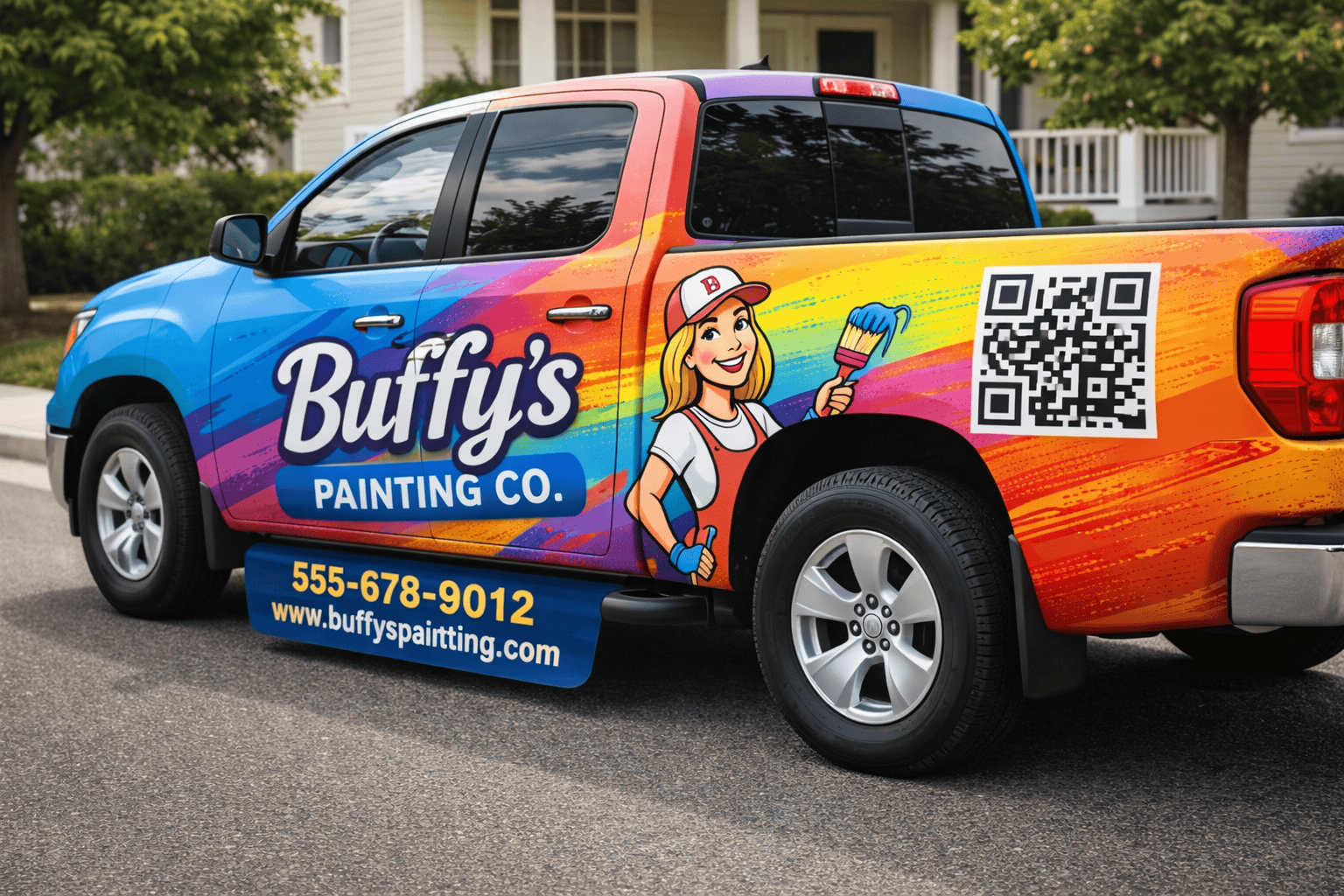
How to Measure Marketing ROI from Your Custom Sticker Campaigns
- December 12, 2025
Marketing accountability has become essential for businesses of all sizes. Every dollar spent on advertising, promotion, and brand building needs to demonstrate tangible returns. Custom sticker campaigns—whether using business signs and graphics for storefronts, vehicle decals for mobile advertising, or product labels for packaging—represent real investments that deserve proper measurement and optimization. Understanding how to track and calculate return on investment from sticker marketing helps businesses make smarter decisions about where and how to allocate their promotional budgets.
Understanding Marketing ROI Fundamentals
Return on investment in marketing measures the relationship between what you spend on marketing activities and the revenue those activities generate. The basic formula divides net profit attributable to marketing by the cost of marketing, then multiplies by 100 to express the result as a percentage. A positive ROI indicates that marketing generates more revenue than it costs, while a negative ROI signals that adjustments are needed.
For sticker campaigns specifically, calculating ROI requires identifying both the total investment and the resulting business impact. Investment includes not just the cost of stickers themselves but also design fees, application labor, and any promotional activities used to distribute stickers to customers. Impact measurement captures new customers, increased sales, enhanced brand recognition, and other business outcomes attributable to the sticker campaign.
Establishing Campaign Baselines
Accurate ROI measurement requires establishing baseline metrics before launching sticker campaigns. Without knowing where you started, you cannot accurately assess how far the campaign moved the needle. Key baseline metrics include average monthly revenue, new customer acquisition rate, website traffic levels, phone inquiry volume, and social media engagement rates.
Document these baselines for at least three months before launching a sticker campaign to account for normal business fluctuations. Seasonal businesses should compare performance to the same period in previous years rather than immediately preceding months. This baseline data becomes the control against which you measure campaign performance.
Tracking Methods for Sticker Campaigns
Different tracking methods suit different types of sticker campaigns. Direct response campaigns—such as stickers featuring special offer codes or dedicated phone numbers—allow precise attribution of customer actions to specific marketing materials. Brand awareness campaigns require more nuanced measurement approaches that capture changes in overall business performance and market presence.
Unique tracking codes provide the most straightforward measurement method. Include a specific promo code on stickers that customers mention or enter when making purchases. This code serves as a direct link between the sticker exposure and the resulting sale. Track redemption rates to understand how effectively stickers drive purchasing behavior.
Dedicated landing pages or URLs printed on stickers allow digital tracking of sticker-driven interest. Create a specific web page that customers can only find through your stickers, then monitor traffic to that page through website analytics. This approach works particularly well for stickers distributed through giveaways or included with product purchases.
According to marketing measurement research compiled by HubSpot, only about 36% of marketers say they can accurately measure ROI across their marketing activities. Implementing proper tracking from the start of your sticker campaigns puts you ahead of most businesses in understanding what works and what does not.
Customer surveys offer another valuable tracking approach. Simply asking new customers how they heard about your business provides attribution data even when technical tracking methods are not in place. Train staff to ask this question consistently and record responses systematically. Over time, patterns emerge showing which marketing channels—including sticker campaigns—drive the most customer acquisition.
Calculating Sticker Campaign Costs
Accurate ROI calculation requires comprehensive cost accounting. Begin with the obvious direct costs: sticker printing, any custom die-cutting or finishing, and shipping. These tangible expenses form the foundation of your investment calculation.
Add design costs, whether paying an external designer or valuing internal staff time spent on creative development. Include revision rounds, file preparation, and any proofing or approval processes. Even if you handle design internally, applying a reasonable hourly rate to time spent provides accurate cost data.
Application and distribution costs often get overlooked. For vehicle graphics, include professional installation labor. For product labels, account for the time spent applying stickers to packaging or merchandise. For promotional giveaways, factor in event costs, staff time for distribution, and any shipping expenses for mailed stickers.
Consider opportunity costs as well. Resources devoted to sticker campaigns cannot be used for other marketing activities. While opportunity costs do not appear in financial statements, understanding them helps evaluate whether sticker campaigns represent the best use of limited marketing resources compared to alternatives.
Measuring Campaign Revenue Impact
Revenue attribution presents the greatest challenge in sticker campaign ROI calculation. Unlike digital advertising with its precise click-tracking, physical stickers generate awareness and interest that may convert to sales through various pathways over extended timeframes.
Start with directly attributable revenue—sales where customers explicitly mention or use sticker-specific promo codes, dedicated phone numbers, or unique URLs. This represents the floor of your campaign's revenue impact, the minimum provable return.
Estimate assisted revenue by analyzing overall business performance during and after sticker campaigns. Compare new customer acquisition, average transaction values, and total revenue to baseline periods. Attribute a reasonable portion of any positive variance to sticker marketing, understanding that multiple factors influence business performance.
For brand awareness campaigns, consider measuring proxy metrics that indicate increased market presence. Website traffic growth, social media follower increases, and unprompted brand mentions all suggest that sticker campaigns are building awareness even when direct revenue attribution proves difficult.
Long-Term Value Considerations
Sticker marketing often delivers returns over extended periods, making short-term ROI calculations incomplete. A vehicle graphic continues generating impressions for years after the initial investment. A product label builds brand recognition with every customer who sees it. Promotional stickers distributed today may drive customer action months later.
Calculate customer lifetime value to understand the true impact of sticker-acquired customers. A customer who initially discovers your business through a bumper sticker may generate years of repeat purchases and referrals. Attributing only their first transaction to the sticker campaign understates its actual contribution to business growth.
Consider brand equity effects that extend beyond immediate sales. Consistent, professional sticker presence builds market credibility and competitive differentiation. These intangible benefits contribute to business value even when they resist precise quantification.
Benchmarking Against Other Marketing Channels
Compare sticker campaign ROI to other marketing investments to inform budget allocation decisions. Different channels deliver different returns, and understanding relative performance helps optimize overall marketing spend.
Sticker marketing typically excels in cost-per-impression efficiency. The physical durability of quality stickers means each unit generates ongoing impressions over its lifetime, reducing effective CPM far below most digital advertising. Vehicle graphics in particular deliver exceptional impression-to-cost ratios that few other channels can match.
However, conversion tracking proves easier with digital channels that offer built-in attribution capabilities. The measurement challenge inherent in physical marketing should not be confused with lower actual performance. Implement the tracking methods described above to develop comparable ROI data across all marketing channels.
Optimizing Future Sticker Campaigns
ROI measurement generates insights that improve future campaign performance. Analyze which sticker types, designs, and distribution methods deliver the strongest returns. Double down on approaches that work while adjusting or eliminating underperformers.
Test different variables systematically. Try alternative designs, messaging, offers, or distribution channels in controlled experiments. Compare results to identify what resonates most strongly with your target audience. Continuous testing and optimization compound returns over time.
Document lessons learned from each campaign to inform future decisions. Build an institutional knowledge base about what works for your specific business, audience, and market. This accumulated wisdom becomes a competitive advantage that improves marketing efficiency over time.
Creating a Measurement Framework
Establish consistent measurement practices that you can apply across all sticker campaigns. Define standard metrics, tracking methods, and reporting formats. Consistency enables meaningful comparison between campaigns and trend analysis over time.
Schedule regular ROI reviews—monthly for active campaigns, quarterly for overall assessment. These reviews should examine both financial returns and strategic insights about customer behavior, market response, and competitive positioning. Use findings to adjust current campaigns and inform planning for future initiatives.
Measuring marketing ROI from sticker campaigns requires deliberate effort but delivers valuable intelligence for business decision-making. By implementing proper tracking, calculating comprehensive costs, and analyzing revenue impact, businesses transform sticker marketing from intuitive guess to data-driven strategy. Start measuring today, and let the results guide your sticker campaigns toward maximum effectiveness and profitability.
Free Shipping
All U.S. orders over $99 receive free shipping (Excluding Hawaii and Alaska). Expedited shipping options available.
No Minimum
Yes, that's correct. We will print any size order you need. Order quantity 1 or 1,000,000
Fast Turnaround
Standard turn around ships within a week. Request rush production for faster turnaround.
Made in the USA
All stickers proudly produced in The Genius Lab by our "Stickologist" just north of Detroit.